Leadership Coaching for Scaling Startups: Why Growth Breaks Systems (and How to Fix It)
Most founders expect scaling to be hard operationally — hiring faster, closing bigger rounds, shipping more product. What catches them off guard is that growth is just as hard on leadership. The habits, shortcuts, and informal decision-making that worked when the team was ten people quietly stop working at fifty, and by the time it's obvious, the founder is firefighting instead of leading.
This isn't a personal failing. It's a structural one — and it's the exact problem leadership coaching for fast-growing companies is built to solve.
The Hidden Cost of Fast Growth
Every founder has felt it: decisions that used to take five minutes now take five meetings. Managers who were promoted for being great individual contributors are suddenly responsible for people, and nobody taught them how. Priorities shift so often that teams stop trusting the roadmap.
None of this shows up on a P&L. It shows up as attrition, missed deadlines, and a founder who's exhausted but can't point to why. The pattern is consistent enough that it has a name in the coaching world: leadership debt — the gap between how fast the org is growing and how fast its leadership layer is maturing.
Why "More Hours" Isn't the Fix
The instinct under pressure is to work harder — more hours, more oversight, more direct involvement from the founder. That works for a while. But it doesn't scale, and it trains the organization to wait for the founder instead of building judgment of its own.
The actual fix isn't effort. It's clarity — in decision rights, in expectations, and in how leaders at every level are expected to operate. That's a structural problem, not a motivational one, which is why it needs a structural approach rather than another pep talk.
A Structural Approach: The 4Ps Leadership Framework™
Most leadership advice hands you tools—how to delegate, how to run a meeting, how to give feedback. The problem isn't that the tools are wrong. It's that they don't stick, because they're taught to people who haven't yet made the shift that would let them use the tools in the first place. You can teach someone to delegate, but if they still believe their value comes from doing the work themselves, they'll take the task back the moment things get tense.
The 4Ps Leadership Framework™ starts somewhere different. It's a diagnostic system—before prescribing anything, it locates where clarity is actually missing. Because most of what looks like a talent problem or a motivation problem is really a clarity problem wearing a disguise. The framework works across four domains, and the order matters:
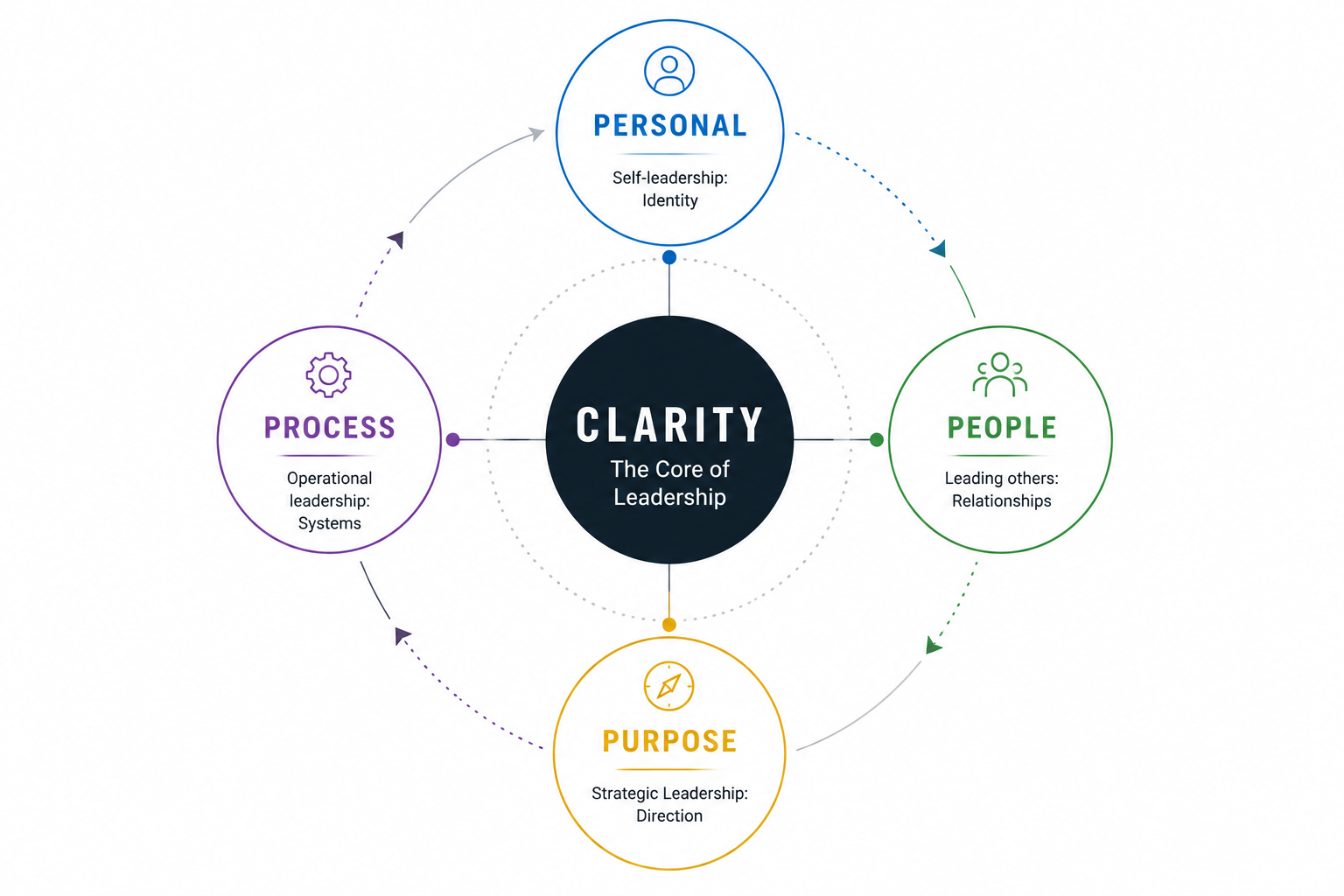
Personal — This is the foundation, and it's the one most programs skip. When someone moves from doing the work to leading the people who do it, the source of their value changes—from what they personally produce to what their team produces through them. If that identity shift hasn't happened, nothing built on top of it holds. A leader who hasn't made it will keep pulling work back, keep being the bottleneck, keep measuring themselves by the wrong scoreboard. Personal is about getting clear on who you now are, before you try to change what you do.
People — Once the identity shift is underway, this is where it becomes visible in how you treat others' work: whether you can hand over real ownership instead of just tasks, whether you develop other leaders or just direct workers, whether you can have the uncomfortable conversation instead of avoiding it. It also covers something most frameworks ignore—whether the leadership team operates as one team, or as separate people who happen to sit in the same meetings.
Purpose — Direction. Not the mission statement on the wall, but whether the people doing the work know why it matters and how their piece connects to where the company is going. When priorities shift fast—which they always do at scale—clarity of purpose is what lets people make good decisions without waiting to be told. Its absence shows up as busywork, misalignment, and teams pulling in different directions while believing they agree.
Process — The machinery. Decision rights, meeting rhythms, who owns what, how competing priorities get resolved. This is what lets good judgment scale beyond one person's head. When it's missing, everything routes back through the founder, knowledge lives in individuals instead of systems, and the company can't operate when key people step away.
What's different about it: most models treat these as four separate things to work on, in any order, or in isolation. The 4Ps treats them as a stack. Personal is the base—the identity shift that makes the rest possible. People, Purpose, and Process build on it and reinforce each other. Work on Process without the clarity beneath it and you get better-run meetings about the wrong things. Work on People without the identity shift and you get delegation that quietly reverses under pressure. And because they're connected, fixing one often lifts the others. That's the real test of whether something is a system or just a list: when you strengthen one part and an untouched part improves on its own, you're looking at a system. That's what the 4Ps is—and it's how our coaching engagements are structured: diagnose which of the four is actually wobbling, start at the layer that has to come first, and build outward.
Signs Your Leadership Layer Needs Support
A few patterns tend to show up right before a founder reaches out:
Every important decision still routes through one or two people, regardless of team size.
Newly promoted managers are struggling, but there's no time to properly onboard them into the role.
Meetings have multiplied, but alignment hasn't improved.
The founder can't take a real week off without things slipping.
Any one of these is manageable. Two or three together usually means the leadership layer hasn't caught up with the company's growth — and that gap only widens on its own.
What Working With a Leadership Coach Looks Like
Good coaching at this stage isn't generic leadership training. It starts with a clear picture of where decision-making is breaking down, then builds the specific habits, structures, and conversations that close that gap — for the founder and for the leaders around them.
If you want to see how that translates into an actual engagement, here's how we work with founders and executive teams scaling through exactly this stage.
Ready to Build Structural Clarity?
Growth doesn't have to mean chaos. With the right structure in place, it's possible to scale the company and the leadership behind it at the same time. If any of this sounds familiar, explore HIVE's coaching solutions or learn more about Alicia's approach.